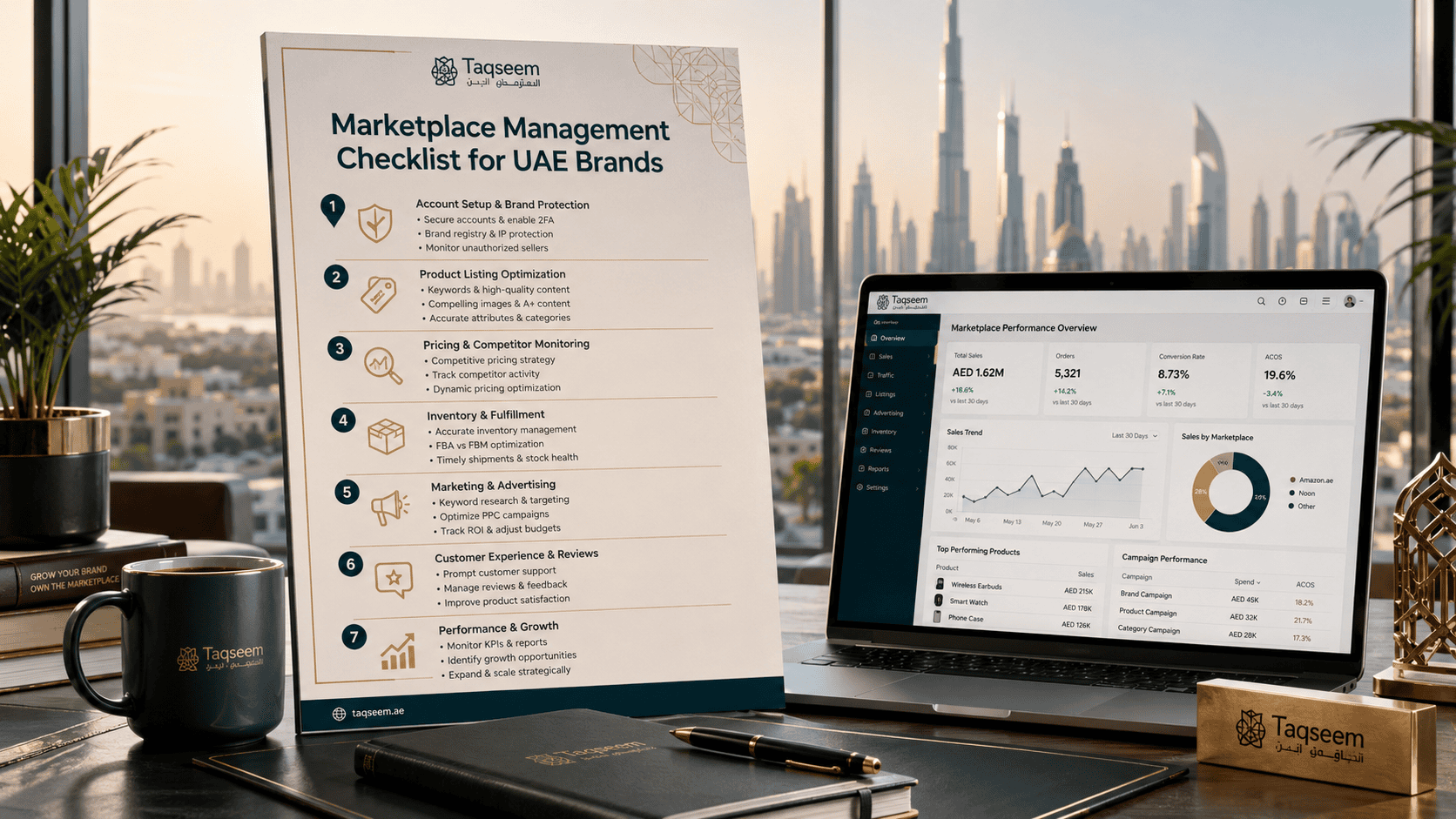
Marketplace Management Checklist for UAE Brands
Selling on marketplaces such as Amazon UAE and Noon UAE can unlock demand, trust, and visibility. But marketplace growth does not come from uploading products once and waiting for orders. It requires weekly management across account health, catalogue quality, pricing, inventory, advertising, reviews, promotions, and reporting.
Use this checklist to audit and improve marketplace performance for UAE brands.
1. Account setup and brand protection checklist
Confirm business documents, VAT information where applicable, bank details, return address, fulfilment settings, seller profile, brand ownership, authorized users, and notification settings. Make sure the account is not dependent on one person’s login or undocumented process.
If the brand is eligible for brand protection or enhanced content options, complete the required steps early. This helps protect listings and improve presentation.
2. Catalogue and listing checklist
Review each SKU for title quality, category accuracy, attributes, variation structure, product description, bullet points, images, search terms, size/weight, warranty, model number, and compliance information. Many marketplace problems begin with poor catalogue structure.
Use consistent naming. Avoid duplicate listings, wrong variations, missing attributes, and keyword stuffing. Each listing should be easy for a customer and marketplace algorithm to understand.
Listing quality questions
Does the title include the main product type, brand, variant, size, and key feature?
Do the first three images explain the product without reading the description?
Are the bullet points benefit-led and specific?
Are variations grouped correctly?
Does the content answer common objections?
3. Image and content checklist
Marketplace images should include white background product images, lifestyle images, scale reference, usage demonstration, benefits, packaging, and comparison where allowed. Weak images reduce click-through rate and conversion.
Content should be written for the buyer, not only the marketplace form. Explain benefits, materials, usage, compatibility, care instructions, what is included, and why the product is different.
4. Pricing and margin checklist
Compare marketplace price against your website, retail partners, and competitors. Calculate marketplace fees, fulfilment cost, returns, promotion cost, advertising cost, VAT impact, and required margin before joining deals or lowering prices.
Do not chase ranking with unprofitable pricing unless there is a clear strategic reason and a time limit.
5. Inventory and fulfilment checklist
Monitor sales velocity, available stock, inbound stock, fulfilment status, stockout risk, slow-moving SKUs, damaged units, and lead times. Stockouts can damage ranking and waste advertising momentum. Overstocking can trap cash.
Prepare stock before campaign periods and seasonal peaks. Align marketplace ads with stock availability.
6. Advertising checklist
Set campaign structure by product group, match type, objective, and budget. Review search terms weekly. Move converting terms into exact match campaigns. Reduce wasted spend on irrelevant queries. Track ad sales, total sales, organic ranking movement, and profitability together.
Ads should not be used to force sales on weak listings. Fix content, reviews, pricing, and stock before scaling advertising.
7. Reviews and customer experience checklist
Monitor ratings, reviews, customer questions, returns, and complaints. Reviews are not only social proof; they are product research. Use negative reviews to improve content, packaging, instructions, product quality, and customer support.
Never use fake reviews or unsafe review practices. Focus on better customer experience and compliant review generation.
8. Weekly marketplace reporting checklist
A weekly report should include revenue, units sold, conversion rate where available, sessions, ad spend, ACOS/ROAS, top SKUs, low-stock SKUs, lost buy box or visibility issues, return reasons, review changes, and action plan for the next week.
Good reporting turns marketplace management from reactive firefighting into structured growth.
Final takeaway
Marketplace management is a weekly operating discipline. UAE brands that manage account health, catalogue quality, content, pricing, stock, ads, reviews, and reporting consistently will outperform brands that treat marketplaces as simple upload platforms.
FAQs
How often should marketplace listings be optimized?
Core listing quality should be reviewed before launch, then performance should be checked weekly. Titles, images, pricing, stock, ads, and reviews should be improved based on data.
What is the biggest marketplace mistake?
The biggest mistake is treating listings as data entry rather than sales pages. Weak content, poor images, wrong pricing, and stockouts reduce performance.
Can Taqseem manage Amazon and Noon accounts?
Yes. Taqseem can support marketplace setup, catalogue optimization, content, ads, reporting, and growth operations.
Leave a Reply