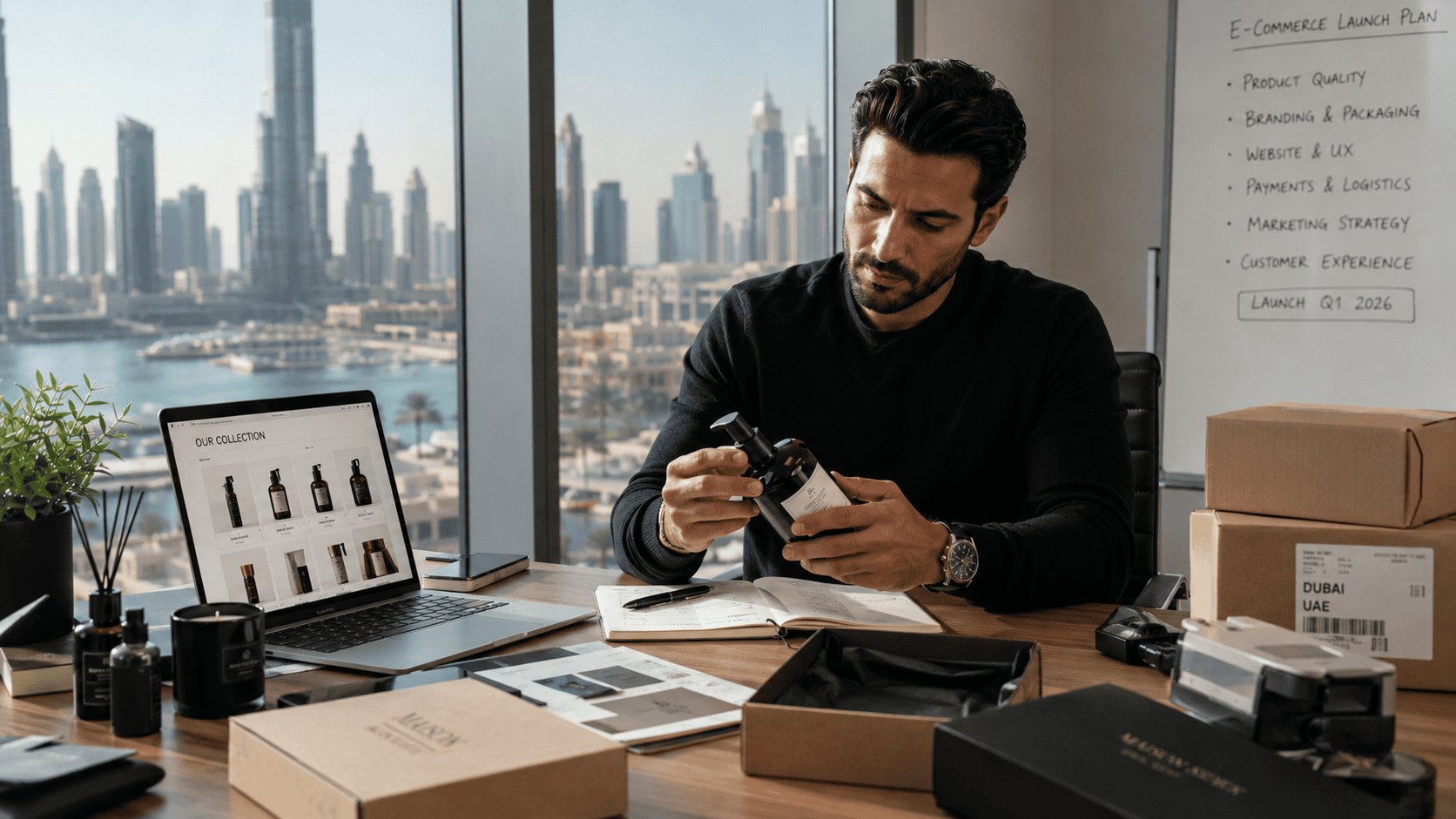
Dubai is one of the most attractive markets in the GCC for ecommerce brands, but it is also one of the easiest markets to enter badly. Many founders start with a website, a logo, and a few products, then discover later that the pricing, fulfilment, licensing, payment gateway, marketplace strategy, and customer acquisition model were not built together.
The UAE is a digital-first market with near-universal internet penetration, strong mobile usage, and customers who compare brands across marketplaces, social channels, Google Search, and physical retail before buying. For a new brand, this means the launch cannot be treated as only a website project or only a marketplace project. The winning approach is a connected commercial system: product-market fit, clear positioning, a trusted sales channel, fast fulfilment, measurable marketing, and repeat-purchase loops.
This guide explains how to launch an ecommerce brand in Dubai in a structured way, so the brand is ready for traffic, sales, fulfilment, reviews, and scale.
Step 1: Choose a niche with commercial demand, not only personal interest
Start with a niche where customers already search, compare, and buy. The best ecommerce niches usually combine visible demand, repeat purchase potential, manageable shipping, healthy margins, and clear differentiation. Avoid choosing products only because they are trending on social media. A trend can create attention, but a brand needs sustainable demand.
Build a simple validation sheet before investing: target customer, product problem, current alternatives, marketplace prices, Google Search intent, social content potential, gross margin, shipping complexity, and regulatory risk.
Practical niche validation checklist
Check Amazon.ae and Noon for current bestsellers and review gaps.
Search Google for buyer-intent keywords such as “best”, “price”, “near me”, “UAE”, and “Dubai”.
Review TikTok, Instagram, YouTube Shorts, and Reddit for customer language and objections.
Estimate landed cost, packaging cost, fulfilment cost, ads cost, returns, payment fees, and VAT impact before deciding the final retail price.
Step 2: Define the brand promise before designing the logo
A logo is not the brand. The brand is the reason a customer should choose you when cheaper, faster, and better-known alternatives are available. Before visual identity, define the positioning: who the product is for, what problem it solves, what outcome the customer gets, and why your offer is meaningfully different.
A good Dubai ecommerce brand should also consider the local audience mix. The UAE market includes Emiratis, Arab expats, South Asians, Filipinos, Europeans, Africans, and global tourists. The brand voice, product photography, payment options, and delivery promise should feel natural to the specific audience segment.
Step 3: Select the right business setup and compliance path
Choose the license and company structure based on your selling model. A DTC website, Amazon/Noon marketplace operation, wholesale distribution model, and retail shop all have different operational needs. Confirm whether the product category needs approvals, labelling, product registration, import documents, or category-specific compliance.
The UAE has modernized digital commerce regulation, and ecommerce brands should treat licensing, logistics, payments, consumer protection, and data privacy as part of the operating model, not as afterthoughts.
Step 4: Build your sales architecture: website, marketplace, social commerce, or all three
Most brands should not depend on a single channel. A website gives brand control, customer data, and long-term retention. Marketplaces such as Amazon and Noon give demand, trust, and discovery. Social commerce creates attention and education. The best mix depends on category, budget, urgency, and margin.
For many new brands, the strongest launch sequence is: start with marketplace research, build a conversion-ready DTC website, launch selected SKUs on Amazon/Noon, then use paid media and creator content to drive traffic into the most profitable channel.
Recommended launch stack
DTC website: brand story, product pages, bundles, reviews, FAQs, and retargeting pixel setup.
Marketplace: optimized listings, keyword-rich titles, images, A+ content or enhanced content where available, stock planning, and review generation.
Social: short-form demonstrations, founder content, customer use cases, and creator-led proof.
CRM: email, WhatsApp, SMS, abandoned cart, post-purchase education, and reorder reminders.
Step 5: Prepare products, pricing, packaging, and fulfilment before running ads
Paid traffic exposes weaknesses quickly. Before running campaigns, make sure your products have competitive pricing, clear product pages, good images, delivery promise, return policy, payment options, and tracking. A beautiful ad cannot fix a weak offer.
For Dubai and UAE customers, speed matters. Same-day or next-day delivery can improve conversion in many categories, but only if the margin supports it. If you cannot compete on speed, compete on trust, quality, bundles, brand story, or specialized assortment.
Step 6: Launch with measurement from day one
Install tracking before traffic starts. You should know where users came from, which pages they visited, what they added to cart, where they dropped off, and which campaigns produced profitable customers. Use Google Analytics, Search Console, Meta pixel, TikTok pixel, marketplace reports, heatmaps, and CRM reporting.
Define launch KPIs before launch: conversion rate, CAC, ROAS, gross margin, order fulfilment time, return rate, review score, repeat purchase rate, and organic search impressions.
Step 7: Scale only after the unit economics are clear
Do not scale only because ads are generating orders. Scale when gross margin, fulfilment cost, return rate, marketing efficiency, and customer satisfaction are stable enough to handle more demand. A brand that scales with weak unit economics often grows revenue and loses cash at the same time.
The right growth model is phased: validate the offer, optimize the website, improve marketplace ranking, launch retargeting, build content assets, introduce bundles, add CRM automations, then expand categories or markets.
Final takeaway
Launching an ecommerce brand in Dubai is not a one-time website project. It is a commercial system that connects product strategy, licensing, branding, website, marketplaces, fulfilment, marketing, analytics, and AI-powered operations. Brands that build this system from the beginning have a much better chance of scaling profitably in the UAE and GCC.
FAQs
H3: How much does it cost to launch an ecommerce brand in Dubai?
The cost depends on license, product category, sourcing, website, content, fulfilment, and marketing budget. A lean launch may start with a limited SKU range, while a serious brand launch should budget for compliance, branding, product photography, marketplace setup, and paid acquisition.
H3: Should I launch on my website or Amazon/Noon first?
For most brands, the strongest approach is to prepare both. Marketplaces give demand and trust, while your own website gives brand control and customer data. The best sequence depends on category and margin.
H3: Can Taqseem help launch the brand from zero?
Yes. Taqseem can support market research, niche validation, brand development, ecommerce setup, marketplace management, marketing, automation, and growth planning.
Leave a Reply