How AI Automation Reduces Ecommerce Operating Costs
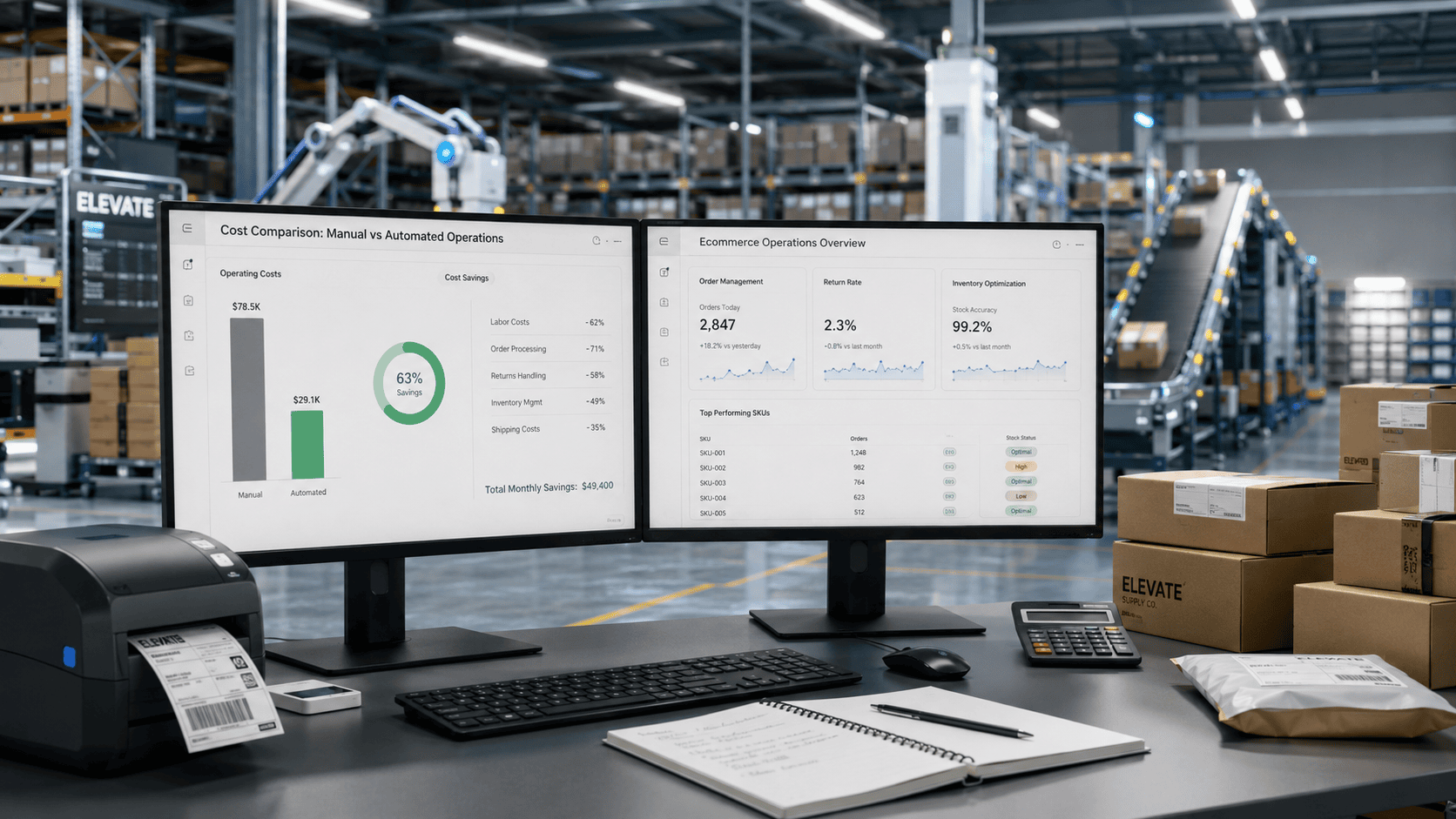
Ecommerce teams often lose money through invisible operational waste: manual reports, repeated customer service questions, delayed stock decisions, slow listing updates, inconsistent campaign tracking, and too many tasks moving between people without clear ownership. AI automation reduces cost by removing repetitive work, improving decision speed, and connecting systems that were previously managed manually.
The goal is not to replace the entire team. The goal is to help the team focus on decisions, strategy, supplier relationships, creative direction, and customer experience while AI handles repetitive workflows.
Where ecommerce operating costs usually increase
Operating costs rise when the business scales faster than its systems. A brand may start with one website and a few SKUs, then add Amazon, Noon, social commerce, paid ads, influencers, WhatsApp enquiries, delivery partners, and customer service channels. Without automation, every new channel adds more manual work.
Common cost leaks include repeated product content creation, manual marketplace uploads, stockouts, overstocking, customer service delays, poor attribution, slow reporting, and campaigns that continue spending after performance has dropped.
AI automation area 1: Customer service and WhatsApp support
AI can answer common questions about product usage, delivery, returns, order status, size guide, warranty, store location, and availability. This reduces repetitive support load and improves response speed. Human agents should still handle complaints, high-value customers, sensitive issues, and complex cases.
The strongest model is a hybrid support flow: AI handles first response and information retrieval, then escalates to a human when needed. This improves customer experience without creating robotic service.
AI automation area 2: Product content and catalogue operations
Product listing work is repetitive and detail-heavy. AI can help generate product titles, bullet points, descriptions, FAQs, image briefs, comparison tables, and marketplace-specific content variations. It can also identify missing attributes, inconsistent naming, weak descriptions, and duplicate SKUs.
The human role remains important: review accuracy, brand voice, compliance, pricing, claims, and category-specific restrictions. AI should accelerate the workflow, not publish unchecked content.
AI automation area 3: Reporting and performance summaries
Many ecommerce teams spend hours collecting data from Shopify, WooCommerce, Amazon, Noon, Meta, Google Ads, TikTok, GA4, and spreadsheets. AI agents can summarize daily performance, highlight anomalies, explain what changed, and suggest actions.
A useful AI report does not only say revenue increased or decreased. It explains the likely reason: traffic source, conversion rate, average order value, stock status, campaign change, creative fatigue, pricing issue, or marketplace ranking movement.
AI automation area 4: Inventory and demand signals
Inventory decisions affect both revenue and cash flow. AI can monitor stock movement, sales velocity, campaign calendar, marketplace ranking, seasonality, and supplier lead time to flag stockout risk or overstock risk. This helps teams buy smarter and avoid emergency decisions.
AI should be connected to a clear rulebook: reorder thresholds, safety stock, minimum margin, promotional calendar, supplier lead times, and slow-moving SKU rules.
AI automation area 5: Marketing workflow and creative testing
AI can help plan campaign angles, generate ad copy variations, summarize performance, detect creative fatigue, build UGC briefs, and organize content calendars. It can also help connect ad performance to product page performance so the team can see whether the issue is traffic quality, offer, landing page, or pricing.
For paid media, automation should support measurement quality. Accurate conversion tracking and first-party data are increasingly important for campaign optimization.
How to start AI automation without overcomplicating the business
Start with one painful workflow rather than trying to automate everything. Choose a workflow that is frequent, measurable, repetitive, and low-risk. Examples include daily sales reporting, customer FAQ responses, abandoned cart follow-up, marketplace content generation, or inventory alerts.
Document the current process, define the desired output, connect the necessary data sources, build the automation, test it manually, then gradually move it into production.
A practical AI automation rollout plan
Week 1: Map repetitive workflows and calculate time spent.
Week 2: Choose one workflow with clear ROI.
Week 3: Build a simple automation using existing tools and data.
Week 4: Test accuracy, escalation rules, and human review.
Week 5 onward: Expand to reporting, customer service, catalogue, inventory, and marketing workflows.
Final takeaway
AI automation reduces ecommerce operating costs when it is connected to real business workflows. The best use cases are not flashy. They are the daily processes that slow the team down: reports, support, catalogue, inventory alerts, campaign summaries, and CRM follow-ups. Start small, measure impact, then scale automation across the operation.
FAQs
Can AI automation replace ecommerce staff?
AI should not be treated as a complete replacement for ecommerce staff. It is most useful for repetitive workflows, reporting, content assistance, customer support triage, and decision support.
What is the best first AI automation for ecommerce?
Daily performance reporting, customer FAQs, abandoned cart follow-up, and catalogue content workflows are usually strong starting points because they are repetitive and measurable.
Can Taqseem build AI agents for ecommerce operations?
Yes. Taqseem can design AI agents and workflow automations for reporting, customer service, content, CRM, inventory, and marketplace operations.
Leave a Reply