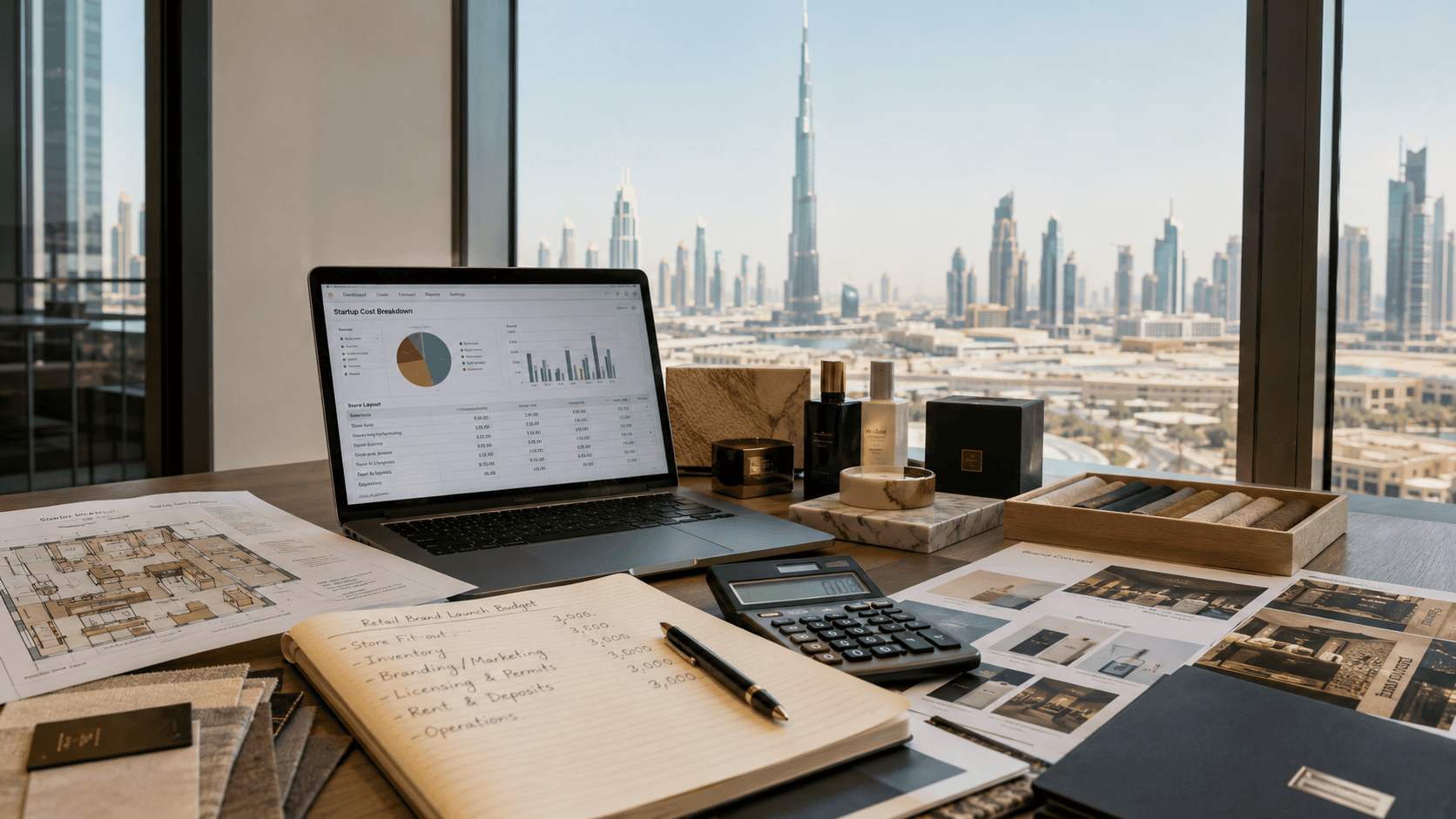
The cost of launching a retail brand in Dubai depends on the product category, business model, sales channels, licensing route, sourcing model, store format, ecommerce setup, marketing budget, and working capital requirement. The biggest mistake founders make is budgeting only for license, rent, and product stock while ignoring brand identity, packaging, photography, marketplace setup, fulfilment, advertising, and cash flow.
This guide explains the main cost heads so founders can plan realistically before launching.
The real cost is not one number; it is a launch system
A retail brand can be launched in several ways: ecommerce-first, marketplace-first, kiosk, shop-in-shop, pop-up, wholesale distribution, full retail store, or hybrid retail plus ecommerce. Each model has a different cost structure. A lean ecommerce-first model may require lower fixed costs, while a physical retail store can require higher upfront investment and monthly overheads.
The goal is not to spend the least. The goal is to spend in the right sequence so every dirham supports commercial validation, customer trust, and repeatable growth.
Cost head 1: Market research and commercial validation
Before spending on stock, validate demand. Research should include competitor price mapping, customer segments, marketplace search data, category trends, product gaps, packaging benchmarks, retail shelf analysis, and margin simulations. This reduces the risk of launching products that look attractive but cannot compete commercially.
Market research is especially important in Dubai because the market is diverse. A product may appeal to one nationality, income bracket, lifestyle segment, or channel but fail in another.
Cost head 2: Business setup, licensing and compliance
Your business setup cost depends on jurisdiction, activity, visa needs, office requirements, category approvals, import rules, and whether you sell online, offline, wholesale, or through marketplaces. Some product categories require labelling, product registration, certificates, or additional approvals.
Do not choose the cheapest license without checking whether it supports your actual business activity and future sales channels. A wrong setup can create delays when onboarding marketplaces, payment gateways, logistics partners, or retail partners.
Cost head 3: Brand identity, packaging and content
Branding is not only a logo. Budget for name strategy, positioning, visual identity, packaging design, brand guidelines, product photography, lifestyle photography, short videos, ecommerce banners, marketplace content, and social media templates. In UAE retail and ecommerce, strong visuals directly affect trust and conversion.
Packaging should also be costed carefully. Premium packaging improves perceived value but can damage margins if material, MOQ, printing, shipping volume, and storage are not calculated.
Cost head 4: Product development, sourcing and inventory
Inventory is usually one of the largest cost areas. Include sample costs, supplier audits, moulds if needed, MOQ, production, quality inspection, freight, customs, storage, damages, and stock buffer. For a new brand, do not over-order only to reduce unit cost. Dead inventory is more expensive than a slightly higher first production run.
A healthy launch range should balance hero SKUs, supporting SKUs, bundles, and future expansion. The range should be large enough to look credible but small enough to learn quickly.
Cost head 5: Ecommerce website and marketplace setup
A retail brand now needs a digital shelf even if the main sales channel is offline. Budget for a conversion-ready website, product pages, payment gateway, delivery integration, analytics, email/WhatsApp automation, marketplace listings, catalogue setup, and product feed structure.
A cheap website that cannot convert, track, or scale is expensive in the long run. Build for speed, trust, mobile experience, checkout clarity, and SEO from day one.
Cost head 6: Retail location, fixture and operations
If launching offline, include rent, deposit, fit-out, signage, POS system, staff, uniforms, inventory display, merchandising, utilities, insurance, mall requirements, opening stock, and opening campaign. A retail location should be selected based on customer segment and economics, not only footfall.
For many brands, a pop-up, kiosk, consignment model, or shop-in-shop partnership can be a smarter first step than committing to a full store immediately.
Cost head 7: Marketing and launch budget
Marketing cost should include paid ads, influencer/creator content, launch event or activation, PR outreach, sampling, email/SMS/WhatsApp flows, content production, marketplace ads, retargeting, and creative testing. New brands often underestimate how many creatives are required to find winning messages.
Do not spend the full marketing budget in the first week. Launch in waves: awareness, traffic, conversion, retargeting, review building, bundle testing, and retention.
Cost head 8: Working capital and cash-flow buffer
Retail brands fail when they run out of cash between inventory purchases, payment settlements, returns, rent, salaries, and marketing spend. Keep a working-capital buffer for at least three to six months depending on the model. Marketplace payouts, supplier payments, and ad spend timing must be planned together.
Cash flow should be reviewed weekly during the launch phase.
Final takeaway
The cost of launching a retail brand in Dubai is not only about the company license or store rent. A successful launch requires a planned budget for research, brand identity, product, packaging, ecommerce, marketplace setup, operations, marketing, and working capital. The safest approach is to build a phased launch budget before committing to inventory or rent.
FAQs
What is the minimum budget to launch a retail brand in Dubai?
There is no single minimum because the model changes the cost. Ecommerce-first, marketplace-first, pop-up, kiosk, and full retail store launches all have different budgets.
Should I open a physical store first or launch online first?
Many brands should validate online first, then use physical retail when demand, margin, and assortment are clearer. However, some categories benefit from physical experience and sampling.
Can Taqseem prepare a launch budget?
Yes. Taqseem can prepare a budget model covering product, sourcing, branding, ecommerce, marketplaces, marketing, retail operations, and working capital.
Leave a Reply